
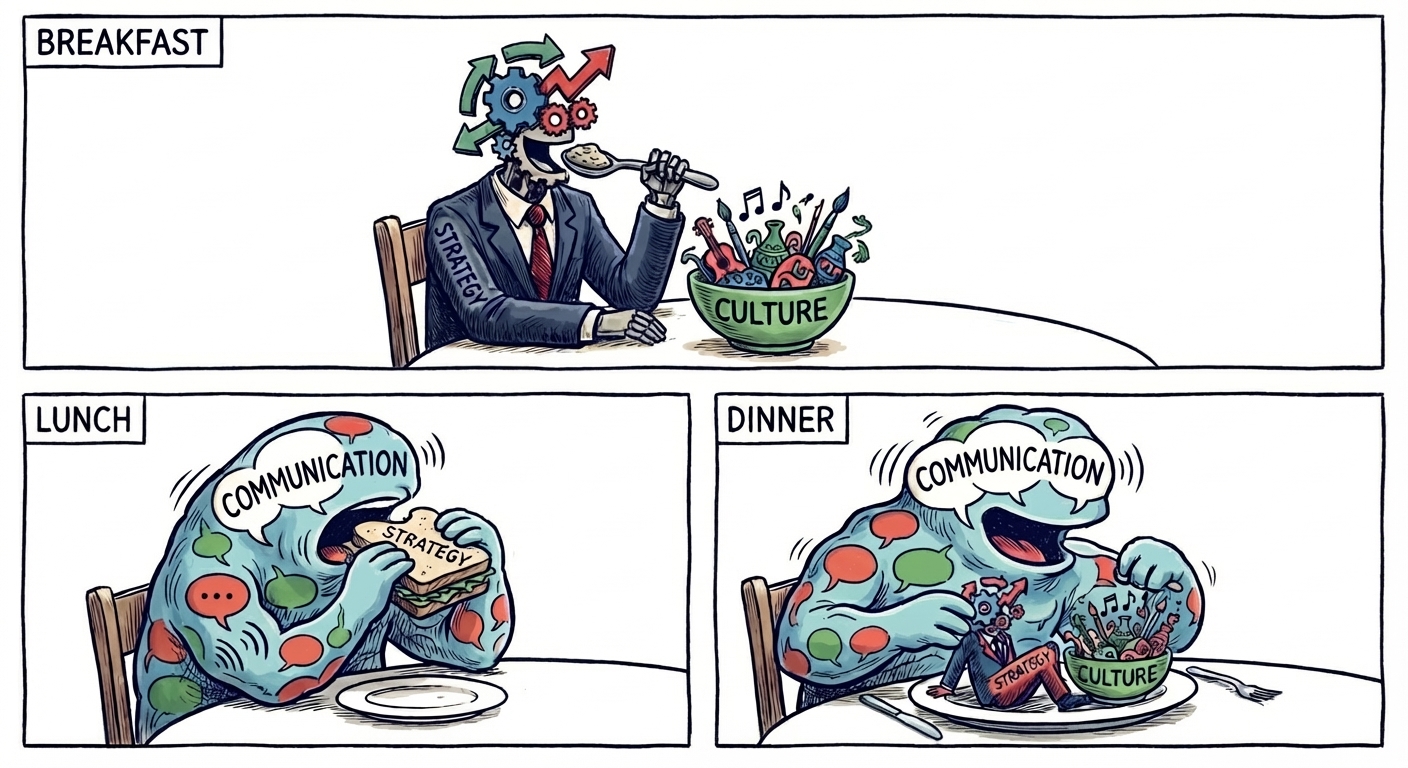
I’m sure most people nowadays are familiar with Peter Drucker’s well used phrase ‘culture eats strategy for breakfast’. Whilst I agree with the sentiment of emphasising the importance of culture, I’ve always had a small issue with the phrasing as it suggests that one is more important than the other when both are of almost equal importance.
Strategy provides a clear direction of travel and a clarity of purpose, responsibility and overall goal(s) as an organisation - without it, organisations can find themselves rudderless and their people demotivated by a lack of defined collective endeavour. Culture is the environment or conditions we create and is built around aspects such as values, habits, attitudes and behaviours - without positive, supportive and effective cultures, Druker is absolutely right, it would be nigh on impossible to deliver on the strategy.
When strategy and culture are both cultivated well, the two go hand-in-hand, with strategy setting clear direction and culture enabling strategy to be delivered effectively. But where does communication fit here? If an organisation has a great strategy and a positive, supportive culture, but isn’t regularly communicating this well to people within and around it, can it really say it’s being highly effective?
Using Druker’s terminology for a moment here, if culture has eaten strategy for breakfast, what should be on the menu for the rest of the day? We all know that breakfast alone is unlikely to sustain us, so if we want energy levels to last the day, we need to think about lunch and dinner. This is where communication comes in. In organisational strategy development, communication is the lunch and dinner to culture’s strategy-based breakfast. Let me explain this further.
I am currently working with several organisations as they shape and develop their strategies for the years ahead. I have worked with upwards of 50 organisations over my career in a similar vein and read upwards of 10 books (and multiple articles) around organisational development, strategy and leadership. These organisations are often sharp, people focused organisations who want to secure the best outcomes for those they serve and work alongside, while also having collaboration and care at their core. Over the years, I am seeing more organisations rightly investing (in terms of time, resources and funding) in effective, meaningful strategy, people and culture development but if I was to pinpoint where a gap remains, it’s in making these things matter to the many audiences the organisation works alongside and serves.
Let’s use an example. Organisation A has spent months developing a great strategy that incorporates the views, ideas and feedback of all layers of the organisation, their partners and stakeholders, and the people they serve. They are getting really positive feedback from people around them that they’ve really valued being part of the engagement work and having an opportunity to contribute. Everything is looking good.
Fast-forward a year or so, and the leader is facing some continuing issues. Parts of the organisation are continuing to work in silos, stakeholders aren’t engaging in ways that support the strategic direction, and those the organisation serves don’t seem to consistently see the value the organisation brings. Communication is likely the common issue here. Not necessarily a lack of it, but potentially a lack of relevant tailoring to meet different audiences’ interests, language and viewpoints.
This is more often than not, just an oversight - particularly when leaders nowadays are so stretched in terms of capacity and time and are likely juggling a hundred and one things at once. But I believe it does often sit at the heart of why even brilliant strategies (with highly supportive, positive cultures to go with it) lose momentum as the months and years go on.
The point I’m making here is that, from my experience, there are still many organisations who develop their strategy and organisational culture really well, yet don’t spend as much time on considering how best to communicate this work to the various audiences they are in regular contact with. I’ve often seen a really well-developed strategy document produced (alongside some great work around the organisation’s vision and values) but it’s shared in the same format (or a very similar one) with Boards, staff, stakeholders and communities alike. As a colleague of mine once said, this hits the target but misses the point. The measure of a well developed and delivered strategy shouldn’t be if and how it’s been shared and communicated, it should be how well that strategy has been understood and absorbed by the various audiences it's been shared with.
I was listening recently to a podcast and on it, the presenter mentioned that she’d visited a hospital recently and a lady got into the elevator with her with a trolley of several trays of food. They exchanged pleasantries and the podcast host asked her ‘what do you do here at the hospital?’. The lady replied ‘Well, I help to save lives’. It wasn’t ‘I’m part of the catering team who provide food to patients’. This was someone who understood why she was there and her role in achieving the organisation's mission.
This simple example illustrates how you know when something (in this hospital case, purpose) has been absorbed and understood. In the case of strategy, you’ll know it’s been fully understood and absorbed when people from different audiences can tell you what the organisation does, how it adds value and some of the ways they have seen it deliver what it’s committed to delivering.
To put this clearly, I am advocating here for as much time and energy to be put into tailored, relevant, regular strategy communication as it is to strategy and culture development. What this means in practice is considering how, once a strategy has been developed, you communicate (and continue to communicate) what the strategy means for different key audiences. In an academy trust (as an example), how you communicate your strategy to parents and communities should be by answering the question ‘what does this mean for my child?’, for staff it would be ‘what does this mean for my role?’ and for the Board it would be ‘what does this mean for the organisation?’.
There will be some questions that some audiences need to know all the answers to (i.e. the Board will want to know the answer to all three of these) but also some who only need the answer to their specific question / viewpoint (such as parents and communities). There are many more audiences and stakeholders in a trust setting of course but I provide just these three here in favour of brevity.
So, keeping this in mind, what questions might leaders ask themselves if they are keen to give communication equal priority to strategy and culture development? Here are a few suggestions:
- It may sound a basic question to begin with, but who are the key audiences for your strategy?
- What does each audience really want to know about your organisation and how can your communication about the strategy help to answer those questions? Consider language within this, aiming to make communication as straightforward as possible.
- How often do you want to communicate with each audience about the strategy and in what ways (written, verbal, video/audio recording)? Sometimes, organisations feel an annual strategy event or communication push is enough when in reality, regularly referring back to the strategy can be helpful in embedding it into people’s everyday lives
- How will you know that you have communicated the strategy effectively to your audiences? What will that look / sound / feel like?
- Who can support you with the communication work? Often, organisations have key people who are well connected, great at influencing and can act as amplifiers for your messages. As a leader, you shouldn’t have to do all of the work yourself, consider who can work alongside you with your communication plans.
- Scaling up plans – what does this look like as we grow? Many organisations go through periods of growth whereby their workforce and/or the people they serve increase significantly. It is worth giving thought to this at the earliest opportunity in relation to how the communication approach you have now, would need to evolve as your organisation scales up.
If you are looking for a specialist with in-depth experience and insights to work alongside you as you develop your organisational strategy, culture and communications, please visit my website at: www.elevatingleadership.co.uk or get in touch at alice@elevatingleadership.co.uk